

Seller-Paid Buydown Raleigh: The Smartest 2026 Budget Path?
AI Summary: A seller-paid buydown Raleigh is a strategic mortgage financing technique where the home seller contributes funds at closing to temporarily or permanently lower the buyer’s interest rate, reducing the monthly payment without the buyer bringing more cash to the table. In the 2026 Raleigh real estate market, this has become a primary way for thoughtful buyers to create immediate affordability while still protecting long-term flexibility. As covered in my in‑depth buydown guide on MartiniMortgageGroup.com, I, Kevin Martini, a Certified Mortgage Advisor in Raleigh, use a fiduciary-style, strategy‑first approach to model these options side by side for specific homes in Wake County. Instead of one‑size‑fits‑all rate quotes, I provide a custom “Strategy Before Structure” review so the seller‑paid buydown you choose in Raleigh, Cary, Apex, Holly Springs, or Garner matches your true holding period, risk tolerance, and financial goals.
Listen to the Podcast Version
Prefer to listen instead of read?
In Episode 243 of the Martini Mortgage Podcast, Kevin Martini explains how seller-paid buydowns work, why many sellers prefer incentives over price cuts, and how buyers can reduce their monthly payment in the early years of homeownership.
Continue reading to see how seller-paid buydowns work in real home purchase scenarios and when this strategy may — or may not — make sense.
Clarity Over Hype in the Triangle
Choosing how to finance a home in the Triangle of North Carolina can feel like a high‑stakes math problem with too many voices and not enough clarity. In 2026, with more choices returning to the market in Raleigh, Cary, Wake County, and across the Triangle of North Carolina real estate, many buyers are no longer fighting for any house; they are choosing the smartest way to own one.
For most 30‑something buyers I work with, the hesitation is not about the home; it is about picking the wrong structure and regretting it later. You have heard “Marry the house, date the rate.” That is the hype. At Martini Mortgage Group in Raleigh, we prefer the math, backed by deeper education. In Mortgage Buydowns Explained: Raleigh, NC Guide (2026), we will focus specifically on when a seller‑paid buydown is the most defensive, strategic move for a 2026 Raleigh‑area buyer and when another path is smarter.

Seller-Paid Buydown Raleigh: A Clear Definition for Local Buyers
A seller‑paid buydown is a seller concession where the seller provides a lump sum at closing—often expressed as a percentage of the purchase price—to buy down your mortgage interest rate and payment. In practical terms, the seller is helping prepay part of the interest so your monthly payment is lower for a defined period or for the life of the loan.
In Raleigh and across Wake County, seller‑paid buydowns most commonly appear in two forms, which I describe in more detail on my Raleigh mortgage buydown guide at MartiniMortgageGroup.com:
- Temporary buydowns (for example, a 2‑1 buydown)
- Your payment is calculated as if your rate is 2% lower in year one and 1% lower in year two, then steps up to the full note rate.
- Permanent buydowns
- The seller pays “points” to permanently reduce your interest rate for the full 30‑year term (or the term of the loan you choose).
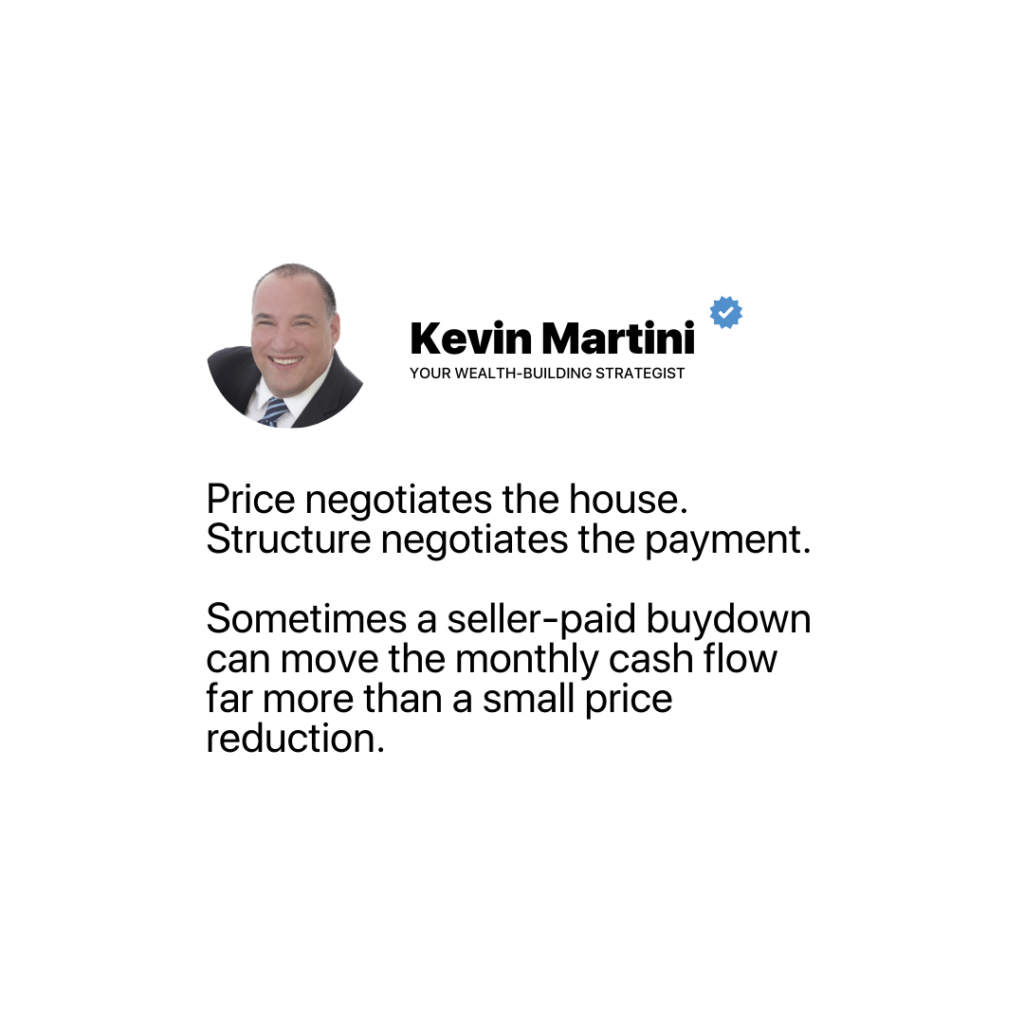
While a price reduction lowers your loan amount, in many realistic Triangle price ranges, a properly structured seller‑paid buydown can create several times more impact on your monthly cash flow during the first years of ownership. That is why the right question for a Raleigh buyer is not “Is a buydown good?” but “Is a seller‑paid buydown the best use of the seller’s money for this specific home and my 2026 budget?”
Who a Seller-Paid Buydown Is Best For in North Carolina
A seller‑paid buydown is not for everyone. It is most effective when the buyer’s situation, time horizon, and the property all align. In 2026, I see it work especially well for:
- The risk‑aware first‑time buyer in Wake County
- You want a “soft landing” in your first one to two years while you adjust to property taxes, utilities, and maintenance in Raleigh, Cary, or Apex.
- A temporary buydown gives you breathing room while you build reserves, rather than stretching to the full payment from day one.
- The “refinance‑ready” strategist in the Triangle
- You are open to refinancing if the math makes sense in the future—but you are not relying on it.
- With a temporary buydown, if you do refinance before the buydown period ends, the way any unused funds are handled is clearly spelled out in your loan documents; part of my job is to make sure you understand that before you commit.
- High‑earning or fast‑growing professionals around RTP
- You work in tech, healthcare, research, or similar fields in Raleigh, Durham, or Research Triangle Park and expect meaningful income growth over the next 24–36 months.
- A buydown lets your payment start closer to your current income and step toward your future earning power.
If you are buying a home in Raleigh, Wake Forest, Holly Springs, or Garner and you recognize yourself in these profiles, a seller‑paid buydown is worth a serious, numbers‑driven look. If not, we may find a different structure that is a better fit.
Benefits of a Seller-Paid Buydown for Raleigh-Area Buyers
When it is the right fit, a seller‑paid buydown can provide several tangible benefits to Raleigh‑area buyers in 2026:
- Immediate cash‑flow relief in the Triangle
- A well‑structured buydown can reduce your monthly payment more powerfully than a modest price cut on the same Wake County property.
- That difference can cover childcare, commuting costs, or just building an emergency fund in your first years of ownership.
- Preserved liquidity for real life in Raleigh
- The seller’s funds do the heavy lifting, so you can keep your own cash for furniture, repairs, or simply a healthy cushion.
- This is especially valuable for first‑time buyers moving from rent to owning in Raleigh, Cary, or Apex.
- Competitive edge in specific Triangle sub‑markets
- In neighborhoods of Cary, Holly Springs, or parts of Raleigh where homes still attract interest, offering near full price with a clear seller‑paid buydown request can look cleaner to a seller than a deep price‑cut offer.
- Potential tax advantages
- When seller‑paid points are used to permanently reduce your rate, they may be treated similarly to buyer‑paid points for tax purposes. Always confirm with your tax professional how this applies to you.
Inside Mortgage Buydowns Explained, I dive deep into the general education. Here, the focus is narrower: using a seller‑paid buydown as a 2026 decision tool to align your monthly payment, cash reserves, and long‑term Triangle plans.
How a Seller-Paid Buydown Works (Step-by-Step)
Here is how a seller‑paid buydown typically works in the Raleigh area when we design it together:
- Identify the property and seller posture
- We and your real estate professional look for homes—often 21–30+ days on market—in Raleigh, Garner, Wake Forest, or nearby areas where the seller is likely open to concessions.
- Strategy session before finalizing your offer
- Using the same “Strategy Before Structure” framework I outlined in Mortgage Buydowns Explained: Raleigh NC Guide (2026), where there is a comparison between 2‑1, 1‑0, permanent buydown, and price‑reduction math for your specific budget.
- The goal is to see which structure delivers the most benefit across the first several years, not just the first 12 months.
- Precise offer language for a seller credit
- Your agent structures the offer with a clearly defined “Seller Credit” earmarked for the buydown, not just a vague “closing cost credit.”
- This helps ensure the funds can be used for the buydown even if they exceed standard closing costs.
- Underwriting at the full note rate
- You are approved based on the full, non‑subsidized payment, so we know you can afford the home even after any temporary buydown period ends.
- This is one of the key risk‑management guardrails I use with 2026 Triangle buyers.
- Escrow funding at closing
- At closing, the seller’s buydown credit is deposited into a dedicated escrow account (often called a custodial escrow account) according to the agreed-upon buydown schedule.
- Monthly subsidy applied to your payment
- Each month during the buydown period, a portion of that escrow is applied to your payment, effectively lowering your out‑of‑pocket cost while the loan itself remains a standard fixed‑rate mortgage.
- Clear expectations for refinance or sale
- Before you commit, we review what happens to any remaining buydown funds if you refinance or sell during the buydown period, based on your specific program and documents.
This process is all about clarity: you know what you pay now, what you will pay later, and what options you have along the way.
Costs, Tradeoffs, and What Changes the Outcome
With a seller-paid buydown, the true “cost” is the seller’s contribution covering the difference between the full note-rate payment and the reduced buydown payments during the buydown period. That cost is already built into the negotiation on the Wake County property. The real decision is not whether you are adding cost at closing — it is how the seller’s money should be deployed to serve your strategy best.
The key tradeoffs
Short-term relief vs long-term savings
If you plan to keep the same mortgage for a very long time and do not anticipate refinancing, a permanent buydown or pure price reduction might create more total interest savings over the decades.
If your focus is the first three to seven years—when career, family, and life expenses are shifting—a temporary buydown can often provide the highest velocity of savings when it matters most.
Seller credit limits and program rules
Every loan type and down payment level has a maximum allowed seller contribution.
We need to be sure the buydown you want fits within those limits and still leaves room for other necessary costs.
Your real comfort with the post-buydown payment
The structure only works if you are comfortable with the payment after the buydown ends—not just the initial payment.
That is why we always build your plan around the full payment first, and then treat the buydown as a benefit — not a crutch.
Reduced buydown payments over the buydown period are funded by the seller’s concession. In other words, that cost is already part of the negotiation on the Wake County property. The real decision is simply how the seller’s money should be deployed to support your long-term strategy.
That is exactly where the Martini Mortgage Group process comes in.
Kevin Martini structures buydown decisions using a two-stage strategy process: first macro strategy, then property-specific math.
During our complimentary Clarity Call, we step back and map the strategy at a macro level. We look at payment comfort, time horizon, negotiation dynamics in the Triangle market, and how seller concessions could be used in different ways — price reduction, closing costs, temporary buydown, or permanent rate improvement.
The goal at that stage is not to force a structure.
The goal is clarity.
Then, when a specific home in Raleigh, Cary, Apex, Holly Springs, or elsewhere in Wake County comes onto your radar, we move from strategy to precision. That is when we run the exact numbers on that specific property, that specific negotiation, and that specific seller concession.
Because the smartest mortgage strategy is rarely built from a generic example.
It is built from the property, the numbers, and your real life.
Common Misconceptions About Seller-Paid Buydowns
Here are misconceptions I routinely clarify for Raleigh‑area buyers:
- “It’s an adjustable‑rate mortgage (ARM).”
- A typical seller‑paid buydown is based on a fixed‑rate mortgage; the note rate does not float.
- The payment is temporarily subsidized by an escrow funded by the seller, then steps up to the fixed note payment.
- “I must be overpaying for the house to get a buydown.”
- Not necessarily. If the home appraises and the numbers make sense, you are choosing how to take the seller’s “discount”—in the form of lower monthly payments or a lower price.
- “The money disappears if I refinance early.”
- What happens to unused buydown funds depends on the specific program and documents.
- Part of my job is to explain exactly how this will work in your case before we decide if a buydown is appropriate.
- “Any lender can easily handle this.”
- Structuring buydown escrows and contract language correctly requires operational precision.
- Not all lenders handle this with the same depth, which is why I prefer to be involved from the strategy stage, not just at the application stage.
These clarifications mirror the education on my broader mortgage buydown content, but are applied specifically to the seller‑paid buydown decision you are making in 2026.
When It Makes Sense and When It Doesn’t
In the 2026 Triangle market, a seller‑paid buydown often makes sense when:
- You are buying a longer‑sitting listing in Raleigh or Garner
- Homes that have been on the market 21+ days often have sellers more willing to offer structured concessions rather than price cuts alone.
- Your comfort‑zone payment is slightly below the full payment
- You can afford the full note‑rate payment but prefer a softer ramp‑up while you adjust to total homeownership costs.
- You want to keep cash available for Raleigh‑area expenses
- You value liquidity for property taxes, commuting, childcare, or simply peace of mind.
It may not be the best fit when:
- The seller will not offer concessions
- In certain hyper‑competitive pockets inside the Beltline or in specific price bands, you may have no room to ask for a buydown at all.
- You are buying a true “forever home” and want a stable payment from day one
- If you plan to keep the same mortgage for decades and dislike any future payment change, we may lean toward a permanent buydown or different structures.
- Your loan program caps seller contributions too low
- If allowed, seller credits are too small to fund a meaningful buydown; it may be wiser to use them for closing costs or a smaller permanent buydown.
The guardrail is simple: if the structure only looks safe in a “perfect” scenario, we keep looking.
Mistakes That Cause Delays or Regret
The most common mistakes I see in the Raleigh and Wake County market around seller‑paid buydowns are:
- Incorrect or vague contract wording
- Writing the offer as a generic closing‑cost credit that exceeds actual closing costs can limit your ability to use the full amount for a buydown.
- The credit needs to be structured in a way that clearly allows buydown use.
- Waiting until after inspections to talk buydowns
- Asking for a buydown late in the process can be much harder than building it into the initial negotiation strategy.
- Focusing on year‑one payment only
- If you only look at the first‑year payment and ignore the post‑buydown payment, you can create future stress for yourself.
- We always plan around the payment you will eventually pay, not just the one you pay today.
- Assuming what worked for a friend will work for you
- Different loan types, price points, and seller situations in the Triangle can make one buyer’s ideal structure a poor choice for another.
Avoiding these pitfalls is part of why I push for a clarity conversation before you submit an offer that assumes a buydown.
How Kevin Martini and Martini Mortgage Group Help
At Martini Mortgage Group, based in Raleigh, my role is to act as your fiduciary‑style mortgage strategist, not simply a rate provider. The detailed, educational foundation lives on MartiniMortgageGroup.com; your 2026 decision lives in a custom strategy session.
Here is how we support you:
- Strategy Before Structure Analysis
- We compare seller‑paid buydown vs price reduction vs higher‑rate with credits vs other structures using your real numbers and realistic Triangle‑specific assumptions.
- Same‑As-Cash Mortgage Approval
- We aim for strong, fully underwritten approvals so your offer is more attractive to sellers, which can increase the odds of securing the concessions you need.
- Clarity‑first Visuals and Conversations
- You see written breakdowns of payments in years 1, 2, and 3, and your “worst‑case” payment if you never refinance.
- We walk through everything in plain language until you feel confident, not pressured.
- Local Raleigh / Wake County insight
- Because we live and lend here, we understand how sellers and agents in Raleigh, Cary, Apex, Holly Springs, and Garner are actually using buydowns right now.
If the analysis shows you are better off with a simpler structure—or even waiting—that is the recommendation you will receive. That is what fiduciary‑style advice means in practice.

TL;DR: Seller-Paid Buydown Raleigh, North Carolina
- A seller‑paid buydown Raleigh strategy uses the seller’s money to reduce your payment, often more powerfully than a small price reduction on the same Triangle home.
- It works best for thoughtful, risk‑aware buyers who want a soft landing, value liquidity, and plan to own in Wake County long enough to benefit from the early‑year savings.
- It may not fit when sellers will not grant concessions, your loan program limits seller credits too tightly, or you strongly prefer a single, unchanging payment from day one.
- The right call is not “always buydown” or “always price cut,” but “Which structure best supports my 2026 budget, time horizon, and Raleigh‑area lifestyle for this specific property?”
- The education foundation is on MartiniMortgageGroup.com; the decision requires a custom, math‑based review of your numbers and your home.
- Ready to see what this looks like for your Triangle home search? Schedule a complimentary clarity call with me, Kevin Martini.