Choosing a Mortgage Lender Raleigh NC: 6 Questions That Reveal the Truth
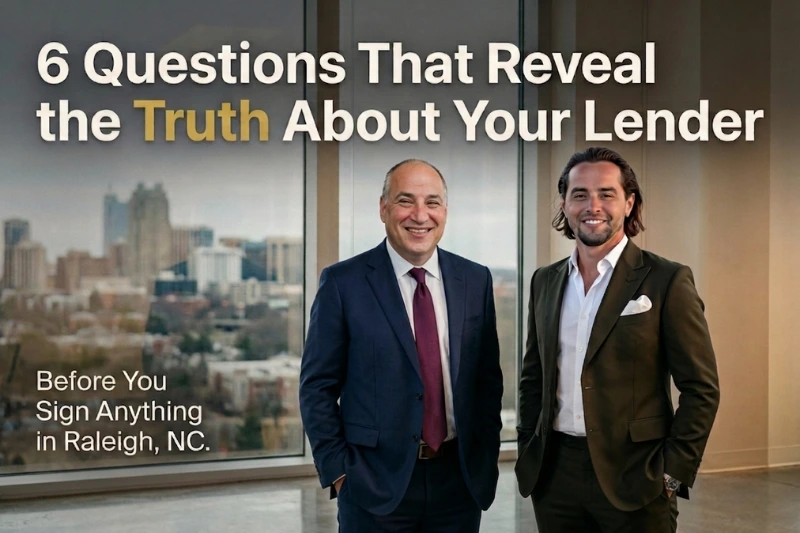
Choosing a mortgage lender Raleigh NC is a decision most first-time buyers make by comparing rates on a screen, then picking whoever answered the phone first. Kevin Martini and Logan Martini of Martini Mortgage Group have reviewed hundreds of buyer situations across Wake County, and the pattern is consistent: the six questions that actually predict a good lender relationship never appear on a rate sheet.
The short version is this. The right lender is not the one with the lowest number on a given Tuesday. The right lender is the one whose process, accountability structure, and local knowledge protect a buyer when something unexpected surfaces inside a North Carolina contract.
Something almost always does.
National mortgage guides focus on rate shopping. They tell buyers to get three quotes, compare APRs, and pick the lowest. That framing is not wrong for a generic market. In Raleigh, Cary, and Apex, where North Carolina’s non-refundable Due Diligence fee means a lender’s failure under contract costs real money, it is dangerously incomplete.
TL;DR — Choosing a Mortgage Lender Raleigh NC: What the 6 questions actually surface
Choosing a mortgage lender Raleigh NC requires a different question set than any national rate-comparison guide provides.
- Rate quotes reflect a single moment in time. Lender execution determines whether a buyer gets to the closing table at all.
- In North Carolina, Due Diligence fees paid to the seller are non-refundable. A lender who misses a condition deadline can cost a buyer thousands regardless of the rate quoted.
- Six questions reveal what a lender’s process actually looks like before an offer is ever written.
- The questions cover underwriting control, communication standards, approval depth, local market familiarity, and file accountability.
- 30-year fixed rates in Raleigh are sitting around 6% in 2026. A quarter-point difference changes a monthly payment by roughly $65 on a $425,000 purchase. A failed closing changes far more.
- The best mortgage lender for first-time buyers in Raleigh is the one whose answers to these six questions hold up under pressure.
Why Rate Comparison Fails First-Time Buyers in the Triangle
A rate is a data point. It is real, and it matters over time. But it captures nothing about what happens when an appraisal comes in low two days before a due diligence deadline, or when an underwriter flags an undocumented deposit the buyer forgot to mention, or when the loan file needs a condition cleared and the processing team is three time zones away.
In Raleigh’s contract environment, those moments are not edge cases. They are normal. And the lender chosen before those moments determines how they resolve.
Someone who chooses a lender based solely on rate comparisons is optimizing for the variable that matters least once the contract is signed.
The 6 Questions That Actually Reveal a Lender’s Quality
Most first-time buyers in Wake County show up to a lender conversation ready to listen. These six questions shift the dynamic. A lender worth trusting answers all six clearly and without hesitation.
Question 1: Do you control your own underwriting?
A lender who controls underwriting in-house can clear conditions faster, adjust to unexpected file developments, and make decisions without waiting on a remote third-party team. A broker who places a file with an outside lender loses control the moment the file transfers. Neither model is automatically better. But the buyer deserves to know which one they’re working with.
In North Carolina, a buyer who needs a condition cleared before a due diligence deadline expires cannot afford to wait on an out-of-state underwriting queue. Understanding who controls the file timeline is not a bureaucratic question. It is a financial risk question.
Question 2: What does your approval process look like before I make an offer?
There is a meaningful difference between a surface-level pre-qualification and a fully underwritten approval. A pre-qualification is built on self-reported numbers. A fully underwritten approval has verified income, documented assets, and a reviewed credit file. In the Triangle, listing agents know the difference, and sellers respond accordingly.
The answer to this question reveals whether the lender front-loads the work or passes the risk to the buyer. The difference between pre-approval and pre-qualification in NC determines how exposed a buyer is if a problem surfaces after the contract is signed.
A lender who cannot explain their approval depth clearly has not thought through their process from the buyer’s perspective.
Question 3: How do you communicate with my real estate agent during the transaction?
Listing agents in Wake County, Cary, and Holly Springs keep informal records of which lenders communicate clearly and close on time. A lender who goes quiet during the due diligence period does not just inconvenience the buyer. They erode the offer’s credibility for future transactions with that agent, in that market.
This question is not about whether the lender is friendly. It is about whether they operate as a collaborative partner in a transaction that involves multiple professionals making time-sensitive decisions. A strong lender is proactive, specific, and on time with every communication the transaction requires.
Question 4: Have you closed loans in this neighborhood or at this price point?
Local familiarity is not a soft advantage. A lender who has processed files in North Raleigh, Apex, Fuquay-Varina, and Cary understands how appraisers in those submarkets behave, what condition requirements surface on specific property types, and what timeline pressures are normal versus exceptional in each market.
A national lender quoting a competitive rate may have no experience with Wake County appraisal patterns or with the specific disclosure timelines North Carolina law requires. That gap does not show up in a rate quote. It shows up at the worst possible moment in a live transaction.
Question 5: How do you handle a file that doesn’t fit a standard W-2 profile?
Many first-time buyers in Raleigh have income profiles that a standard automated underwriting system reads imperfectly. Recent job changes, bonus income, RSU vesting schedules, and self-employment side income all create complexity that a skilled advisor navigates differently than a volume-based lender.
This question reveals whether the lender is building a loan around the actual person or running a file through a checklist. For any buyer whose income has nuance, the answer to this question is the most important piece of information they will receive.
Understanding whether the lender evaluates structure before recommending products is the same principle explained in depth at why the lender conversation comes before house hunting in Raleigh.
Question 6: What happens if a problem surfaces after we’re under contract?
This is the question almost no one asks. It is the one that separates a transaction-focused lender from a fiduciary-style advisor.
A good answer names specific steps, explains who on the team manages escalations, and describes how the lender communicates with the buyer and agent when conditions require action under deadline. A vague answer — “we’ll figure it out” or “that rarely happens” — is information too. Raleigh’s Due Diligence contract structure means that rare problem arrives at the worst possible moment. A lender who has not thought through the answer in advance has not thought through what they owe the buyer.
The deeper question this surfaces is whether the lender’s loyalty is to the buyer’s outcome or to closing volume. That distinction defines the difference between mortgage broker vs bank for first-time buyers in Raleigh in ways no rate comparison captures.
What a Lender’s Answers Reveal About Their Process
These six questions are not a gotcha test. They are a process reveal. A lender who has built a buyer-first operation answers them the same way every time: specifically, without defensiveness, and with examples drawn from real transactions in Raleigh and the Triangle.
A lender who gives vague, rushed, or evasive answers to any of these questions is telling the buyer something important before any money is at stake.
The goal of the conversation is not to expose a lender. It is to find the one who treats a first-time buyer’s financial exposure with the same seriousness the buyer brings to it.
What We See in Raleigh at The Martini Mortgage Group
Kevin Martini here. The most common pattern we see with first-time buyers who come to us after a difficult experience with another lender is a version of the same story: the rate looked good, the lender seemed responsive at first, and then something unexpected happened under contract, and there was no clear owner of the problem.
Logan Martini and I field these six questions every time a buyer sits down with us, because we built our process around the answers being verifiable — not just sayable. We are a delegated correspondent lender, which means underwriting happens under our roof. We communicate directly with agents throughout every transaction. And our Same-As-Cash Mortgage Approval is a fully underwritten file, not a pre-qualification letter dressed up with a better label.
We have worked with buyers in Holly Springs who thought they were ready and weren’t, and buyers in Morrisville who thought they weren’t ready and were. The file tells the truth. Our job is to read it clearly and explain it honestly.
The Question Behind the Questions
A first-time buyer in Raleigh is not just choosing a loan product. They are choosing who manages their financial exposure in the most consequential transaction of their life so far.
The six questions above are diagnostic tools. They surface the difference between a lender who is set up to protect a buyer and one who is set up to close volume. That difference rarely appears in a rate sheet. It appears in how a lender handles the moment when the transaction gets complicated.
In Raleigh, Wake County, and across the Triangle, that moment comes often. The buyer who asks the right questions in advance is the one who already knows what to expect when it does.
The Same-As-Cash Mortgage Approval at Martini Mortgage Group is built around a fully underwritten file completed before any offer is written, so when that moment arrives, the buyer’s financing is the strongest element of the offer rather than the most uncertain one.
Someone who has read this far is not window shopping for a mortgage. They are trying to make the right decision the first time. That instinct is correct. The lender chosen before the first offer is written shapes every moment that follows.
A no-obligation, judgment-free clarity call with Kevin Martini and Logan Martini at Martini Mortgage Group covers all six of these questions directly, models the loan structure that fits the actual file, and produces a clear answer on what the buyer’s verified position looks like before any home is toured. There is no sales pressure, no vague reassurance, and no one pushing a product before the picture is complete. Start at martinimortgagegroup.com.