
Will Home Prices Drop in Raleigh in 2026 or 2027?
Will home prices drop in Raleigh in 2026 or 2027?
For most buyers, probably not in a dramatic way.
The Raleigh housing market is shifting, but the data points toward stabilization—not a significant price decline. Strong population growth, limited long-term supply, and continued demand across Raleigh, Wake County, and the Triangle suggest that prices are more likely to flatten or grow slowly than fall sharply.
Many buyers asking this question are trying to avoid making the wrong decision—not just today, but years from now.
This is the question almost every buyer eventually asks.
“What if I wait… and prices drop?”
It sounds smart.
It feels safe.
But in most cases, it’s based on a misunderstanding of how markets like Raleigh actually behave.
Why a Major Price Drop in Raleigh Is Unlikely
Raleigh is not a boom-and-bust market.
It is a growth market.
That distinction matters.
Raleigh continues to be driven by:
- Population growth
- Job expansion tied to Research Triangle Park
- Relocation from higher-cost markets
- Long-term demand across Wake County
These factors create a floor under home prices.
Prices may slow.
They may level off.
But a sharp drop requires something deeper—like a major economic disruption or oversupply.
And right now, neither condition is dominant.
National data from sources such as the National Association of Realtors continue to show that housing supply remains constrained relative to demand in many growth markets.
If you want a broader view of where the market is heading, start with our Raleigh housing market 2026 forecast.

What Is Actually Happening to Home Prices in Raleigh Right Now
The Raleigh market isn’t crashing.
It’s normalizing.
That means:
- Price growth is slowing
- Sellers are adjusting expectations
- Buyers have more negotiating power
This is not a price collapse.
It’s a shift in leverage.
Waiting can improve one variable… but worsen the rest.
The Hidden Risk of Waiting for Prices to Drop
Most buyers think:
“If prices drop, I’ll get a better deal.”
But they miss what usually happens at the same time.
- Demand shifts quickly when rates move
- Lower rates bring more competition
- Increased demand stabilizes or raises prices
So the window to “buy low” is often short, competitive, and unpredictable.
Buy Now vs Wait: What Actually Changes
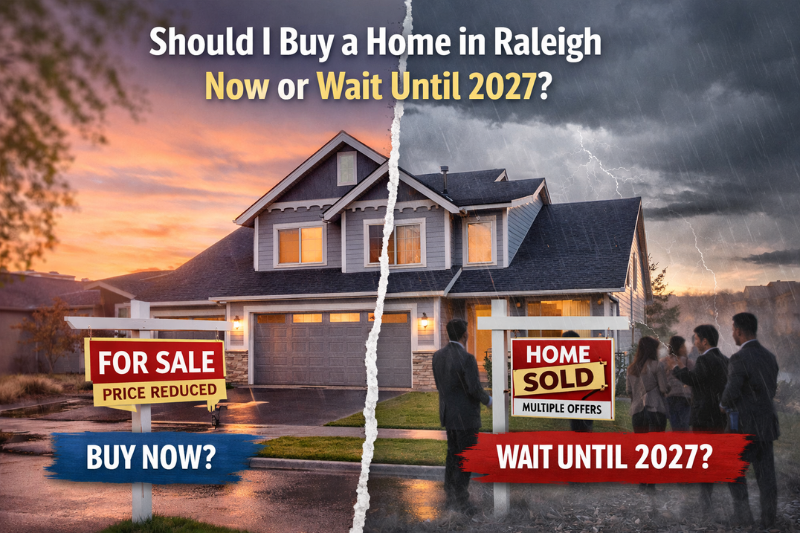
If you’re deciding between acting now or waiting, here’s what really shifts:
If you buy now:
- More inventory = more choices
- Less competition = more negotiating power
- Sellers more open to concessions
If you wait:
- Rates may improve
- Prices may flatten
- Competition likely increases
If you want a full breakdown, read our guide on whether you should buy a home in Raleigh now or wait until 2027.
What This Means for Raleigh Homebuyers Right Now
The Raleigh market is offering something rare:
Balance.
- More time
- More choice
- More negotiating flexibility
But those advantages don’t last forever.
They exist in transition markets, not peak ones.
The Advantage Most Buyers Miss
Preparation—not timing—is the real advantage.
Buyers who go in fully underwritten, with a Same-As-Cash Mortgage Approval, can:
- Move faster
- Negotiate stronger
- Compete with confidence
So… Will Home Prices Drop in Raleigh?
Not in a way that meaningfully improves your outcome.
- Prices may stabilize
- They may grow slowly
- But a major drop is unlikely
The real risk isn’t buying at the wrong time.
It’s waiting for something that never meaningfully happens.
What’s the Right Move for You?
There is no one-size-fits-all answer.
But there is a right strategy.
If you want to understand how this applies to your situation, the next step isn’t guessing—it’s clarity.
At Martini Mortgage Group, we take a fiduciary, strategy-first approach to help you understand your options, your numbers, and your timing—so you can move forward with confidence.
If you want a private, one-on-one strategy conversation, you can connect directly with Kevin Martini or Logan Martini to map out your next step.